Introducing the 2018-19 Youth Advisory Board
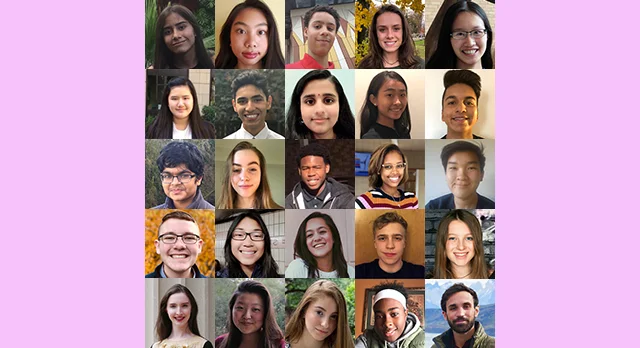
We are thrilled to announce the new members of our 2018-2019 Youth Advisory Board (YAB). The board represents a diverse group of young people who will work with Making Caring Common this academic year to make schools and communities more just, caring, and respectful places.
As part of YAB, students will collaborate with one another to help address some of the most pressing ethical and moral issues facing young people today. Board members will provide feedback on Making Caring Common strategies and initiatives and share their perspectives on current events and issues in the media. They will also implement year-long projects to develop their leadership skills and cultivate a culture of kindness in their schools and communities.
The 25 members of the 2018-2019 board were selected from a pool of more than 220 applicants in grades 9-12 in the United States. The board represents 19 states across the country, as well as a diversity of backgrounds and identities. This year’s members are united by their strong commitment to empathy and promoting MCC’s mission of raising kids who care about others and the common good.
Read More
Update: November 2018
Read the November update from Making Caring Common and don't forget to sign up for our monthly newsletter to get updates straight to your inbox.
Read More
In the News: What today’s parents can do to raise the next generation of informed voters
In this article in The Washington Post, Rick Weissbourd says, “Voting should be a fundamental expectation that parents have for their children. Make it clear that your family believes being an engaged citizen is a moral responsibility because other people’s lives — and the well-being of our community and country — depend on it.”
Read More
In the News: The Fierceness of Mister Rogers
In this article on the Harvard Graduate School of Education website, Making Caring Common’s Rick Weissbourd says that he has found that men can sometimes tune out when terms like “empathy” and “listening” are used to talk about the importance of caring, but they can be more engaged by terms like “courage” and “respect.”
Read More
Welcome to our new website!
We’re thrilled to share our new website with you!
We’ve heard from many people over the years that they appreciated our reports and loved our resources — but weren’t always able to find what they were looking for on our old website.
Our new website is designed to make our work — including Reports, Research + Initiatives, Resources for Educators, Resources for Parents, and Resources by Topic — more accessible and more actionable for our visitors.
Read More
In the News: Elite-College Admissions Are Broken
In this article in The Atlantic, Richard Weissbourd says that "There's a disease in that so many people are focused on 10 to 20 highly selective colleges that aren’t any better than 100 other colleges,” If we don't crack this disease, this obsession, "we can't get rid of achievement pressure."
Read More
In the News: 5 ways parents can help kids understand consent and prevent sexual assault
As parents and caregivers, we must do better to prevent children and youth from harming or being harmed, and to help them become caring, humane people. We have tremendous power to shape their understanding of assault and consent, and to be part of the solution to this destructive epidemic. In this article in The Washington Post, MCC leaders Rick Weissbourd and Alison Cashin offer five guideposts to help parents begin these essential conversations.
Read More
In the News: How Fathers Should Talk With Their Sons About Sex in the #MeToo Era
In this piece in The Wall Street Journal, Making Caring Common’s report The Talk is cited. Difficult conversations about sex and consent have become even more complex — but here’s how dad’s can persist.
Read More
Special Update: October 2018
We need to talk to young people about misogyny, sexual harassment, and assault.
Amid the bitterly polarizing events of the past week, there seemed to be one point of agreement on both sides of the aisle: Sexual assault is an epidemic in this country, with devastating and long-term repercussions for survivors. We also saw that many survivors—for a number of complex reasons—are unwilling to come forward to report their experiences or even discuss them with trusted friends and family.Parents, caregivers, and educators are our first line of defense in preventing misogyny and sexual harassment, and in raising our children—our boys in particular—to clearly understand and take seriously sexual assault and consent. But as we discussed in our report, The Talk, although rates of sexual harassment and sexual assault are alarmingly high in this country, most parents and educators are not having these critical conversations with the young people in their lives.
Read More
In the News: ‘Think of your sons’: What parents can do about sexual assault in the #MeToo era
In this Washington Post article, Making Caring Common’s research is cited: most parents don’t talk to their boys or girls about making sure that their partner wants to have sex, not pressuring someone into sex, not having sex with someone who is incapacitated and other key aspects of consent. Parents may have “the talk” with their kids, but it’s often much more focused on preventing pregnancy and STDs than on preventing assault.
Read More
In the News: Let's Take a Stand Against Sexual Harassment in Schools
In this post in the Association for Supervision and Curriculum Development, the deep infection of sexual harassment and misogyny in workplaces and communities across this country has erupted into a national conversation—one appallingly overdue. But we can't stop sexual harassment and misogyny in adulthood without addressing its deep roots in gender roles and expectations in childhood.
Read More
In the News: We Can’t Just Let Boys Be Boys
In this article in The New York Times, Making Caring Common’s survey of more than 3,000 18- to 25-year-olds is cited. More than 60 percent of respondents had never had a single conversation with their parents about how to be sure that your partner wants to have sex with you.
Read More
In the News: End College Rankings: An Open Letter To The Owners And Editors Of U.S. News And World Report
Linear rankings of many consumer products make sense: the undergraduate experience is too diverse and complex to be reduced in this way. Please, rank cars, rank vacations, rank stocks, rank hospitals, you can even continue to rank college towns if you need to, just don’t rank schools.
Read More
Update: September 2018
Read the September update from Making Caring Common and don't forget to sign up for our monthly newsletter to get updates straight to your inbox.
Read More
In the News: In the age of Trump, there's a fine line between racism and free speech. Even at high school football games
In this piece in the Los Angeles Times, Rick Weissbourd says that “[students] have the right to free speech, but they don’t have the right to degrade other people.”
Read More
In the News: When applying to college, this character trait may mean more than grades
In this Washington Post On Parenting piece, Making Caring Common’s work on college admissions is cited: “A recent report by the Harvard Graduate School of Education, Making Caring Common, speaks to this. Colleges want students who care. They are drawn to applicants who show concern for others, promote good citizenship and civic engagement and develop personal responsibility.”
Read More
In the News: Positive Parenting: Having 'The Talk'
In this segment for WFMZ, Rick Weissbourd discusses our report "The Talk" and the important conversations about sexual harassment and consent parents need to have with their kids.
Read More
Update: August 2018
Read the August update from Making Caring Common and don't forget to sign up for our monthly newsletter to get updates straight to your inbox.
Read More
In the News: 9 ways parents can help kids cope with jealousy
At its core, jealousy is about insecurity, fear, or a sense of competition. The emotion has been around forever, notes Richard Weissbourd. The Greeks wrote about it. Shakespeare wrote about it. It’s in the Bible. But there’s no point trying to vanquish the emotion. Here are ways parents can help their children recognize and respond constructively to jealous feelings. Read more in this article in The Washington Post.
Read More
The New York Times: Happy Children Do Chores
In this article in The New York Times, Making Caring Common’s research on the power and frequency of parents’ messages about achievement and happiness is cited. Although household chores seem like a small thing, the subtle but pervasive message of requiring them isn’t small at all. Requiring a high schooler to contribute to the family well-being and the smooth running of the household before turning his attention to his books conveys the value you place on that contribution.
Read More